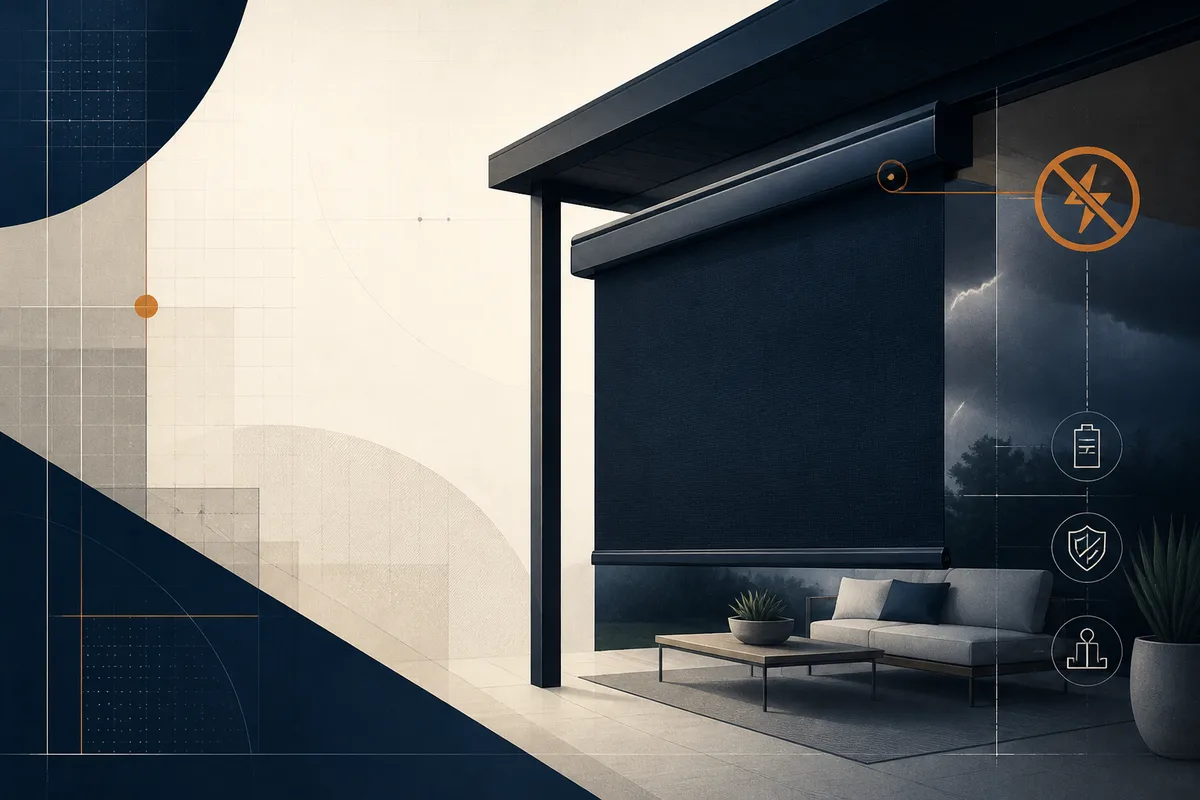
Preventing Entrapment During a Motorized Screen Power Outage
Homeowners often face a sudden dilemma when a severe thunderstorm triggers a power failure: a large-span motorized screen is deployed, and the winds are picking up. If the screen remains down, the mesh acts as a sail, potentially damaging the tracks or the motor housing; if it is stuck up, the outdoor living space is exposed to debris and rain. Relying solely on a standard electrical connection leaves the enclosure vulnerable to the 70 percent of organizations and systems that face a power outage annually, according to the Ready Business Power Outage Toolkit.
The choice between a manual override and a battery backup system is a trade-off between mechanical certainty and electronic automation. This comparison breaks down how each system handles specific stressors, from sudden voltage drops to extended grid failures. Whether securing a lanai in Highland Park or a Garage Screen enclosure in Plano, understanding the mechanics of emergency release ensures the investment survives the season.
Why Standard Motorized Enclosures Fail in Storms
Standard motorized units lack an internal energy reservoir, meaning they lock in their current position the moment the circuit breaks. This creates several operational hazards during regional weather events:
- Wind load on a static screen can pull the fabric out of the side tracks, leading to expensive re-tensioning repairs.
- Inhabitants can become "boxed in" on a patio if the screen is the primary exit point and the power fails.
- Rapid power cycling during a storm can confuse motor limit settings, as sophisticated equipment can be damaged by surges or forced into prolonged restarting processes, according to the Anesthesia Patient Safety Foundation.
- Attempting to force a screen up by hand without a release mechanism will almost certainly strip the internal drive gears.
The Strategy for Emergency Screen Operation
1Evaluate the Manual Override Requirement
A manual override, or "manual limit" motor, features a secondary gear head that accepts a hand crank. This is a purely mechanical connection that functions independently of the electrical system. It provides a reliable motorized screen power outage solution that can be utilized when electrical operation is impossible, as noted by Shutters and Shade.
2Assess Battery Backup Responsiveness
Battery backups, often called Uninterruptible Power Supplies (UPS) for screens, provide stored energy to maintain operation when the main utility fails. These systems are ideal for homeowners who may not have the physical strength to use a hand crank on a wide screen. The system detects the loss of utility power and allows the user to retract the Motorized Patio Screens using the standard remote control.
3Factor in Local Grid Instability
In the North Texas area, power issues often stem from downed lines during high-wind events. Residents can monitor local conditions and report hazards through the Public Utility Commission of Texas. If a property is in an area prone to frequent "brownouts" or micro-outages, a battery system prevents the motor from losing its programmed "home" position during flickers.
4Implement a "Storm Ready" Protocol
Regardless of the technology chosen, the best strategy is proactive retraction. If the sky turns dark, retract the screens while the grid is stable. Emergency systems should be viewed as a last resort for when the motorized screen power outage occurs unexpectedly, rather than a primary way to manage the screen during every storm.
The Mechanics of the Manual Crank
The manual override uses a "wand" or crank handle that hooks into an eyelet located at the end of the motor hood. When the handle is turned, it engages a worm gear that rotates the roller tube. While this is a reliable fail-safe, it is a slower process than motorized operation. For wide-span units, this can be physically taxing, making it essential to test the mechanism annually to ensure the gears remain lubricated and clear of debris. Referencing the model manual for specific override instructions is essential for safe operation.
How Motorized Screens of Dallas Helps
Navigating the technical requirements of emergency power systems requires an onsite assessment of the existing electrical load and mounting clearances. A typical engagement involves inspecting the motor head accessibility to determine if a manual wand can be operated without obstruction from soffits or gutters. Specialists provide guidance on integrating backup power that complies with local standards while ensuring the mesh remains protected. For residents seeking a resilient outdoor setup, outlining a clear scope of work that includes both insect protection and emergency egress is the standard professional approach.
Frequently asked questions
Can I add a manual override to my existing screen motor?
No, a manual override usually requires a specific type of motor with a built-in gear box designed for a crank. If your current motor does not have the eyelet for a wand, the entire motor unit typically needs to be replaced to gain this functionality.
How long does a battery backup last during an outage?
Dedicated screen battery systems are intended for emergency use to move the screen to a safe position rather than continued daily operation throughout a multi-day blackout. The duration of standby time and number of available cycles varies based on the battery capacity and the power draw of the specific motor.
Is a manual override hard to use on wide-span screens?
The difficulty depends on the gear ratio of the motor. While the gears provide a mechanical advantage that makes the weight manageable, the number of turns required to lift a tall, heavy screen can be tiring for some users.
What happens if my screen is halfway down when the power goes out?
Without a backup or override, the screen will stay in that position. This is a vulnerable state during a storm, as the mesh can "pocket" wind, increasing the risk of damage to the tracks or structural components.
Do these systems require special maintenance?
Battery backups should be tested periodically to ensure the cells still hold a charge. Manual overrides require a quick "dry run" once a year to make sure the eyelet hasn't become seized by paint, dirt, or nesting insects.
Will my home automation app work during an outage?
Generally, no. Even if your screen has a battery backup, your home's Wi-Fi router will likely be down unless it also has a backup power source. In these cases, you must use a standard radio-frequency (RF) remote or the manual crank.
What happens when you get in touch: you describe the situation, we ask the few questions that actually change the answer, and you get a clear scope and next step — no obligation.